|
Prof. R. Freund: It is buried in the Donana's Marshes in southern Spain |
||||
|
New research is emerging that provides strong evidence that Atlantis is buried beneath the large marsh of Coto de Donana Park in southern Spain, a vast swampy area south of Seville and north of the Spanish port of Cadiz (Gadeira or Gadara in ancient Greek language). Μan international team of Spanish, Canadian and American scientists, led by American archaeologist Richard Freund of Hartford University in Connecticut, began research in 2009 to study the wetland. This was first observed as a possible location for Atlantis by a German scientist looking at various satellite images in 2003. Freud's team's research and findings were presented in a special show (film) entitled "Finding Atlantis" on the National Geographic channel , on Sunday 13/3/2011.
The case began in 2003 with the German scientist reporting that what he saw in satellite images of the subsoil of the "Coto de Donana" national park area looked like a circular structure with a straight line connected to it. Over the next few years, others thought that the visible structures in the satellite images were similar to the island of three concentric circles with a single entrance in and out as described by Plato in his account of Atlantis, written around 360 BC. Plato also placed Atlantis near the "Pillars of Hercules", known today as the Straits of Gibraltar, which connect the Atlantic Ocean to the Mediterranean Sea. Presented in the National Geographic film, Professor Freund explained how his team worked to discover the lost civilization at the bottom of the Donana Park marsh, using deep-ground radar, digital photography, satellite imagery of submarines and underwater equipment for diving and scanning the bottom of the Atlantic Ocean around the area. "I think we found the best candidate for what the beginnings of civilization were .... one of the largest and most ancient cities at the bottom of a huge marsh," Freud said, claiming that it was Atlantis described by Plato in 360 BC. It is buried in the Donana National Park north of Cadiz, and it is a given that this area was once in an open bay that was destroyed and filled with mud by a giant tsunami. "This is the power of the tsunami," he said. "Although it is so hard to understand that this wave can wipe out to 60 miles inland. That's pretty much what we are taliking about." Regarding the difficulties and challenges encountered in researching this area, Freund said: "I have become an expert in places that have become silted in. But it was very difficult to make any excavation inside the swampy national park. The ground is constantly covered with water and mud for 11 months a year. Even in August and September the water table was very high." Freund and his team transported their equipment to the area during the driest months of the year, August and September, in 2009. "By shooting electricity into the ground we can distinguish between different types of material. This type of technology can map the whole subsurface instead of digging .... It's a form of non-invasive archeology." "We have mapped the subsurface. It is like an MRI for the ground," he added. The images obtained from the electrical imaging of the ground show interruptions in the subsurface densities compatible with the circular patterns that are visible from above. What the team found in the electrical mapping of the subsoil was a pattern that was repeated at regular intervals, something that does not occur naturally. While satellite images identified structures that appeared to be buried in swamps. In addition to advanced scientific mapping, core samples were collected from 13.5 meters deep, into the silt and wood chips, which were given for testing. Carbon dating of the material nuclei was also confirmed, which confirmed that there was human activity in this area about 4400 years before our days. However, finding the core samples, the team inadvertently found something interesting. A mysterious layer of methane that may mean flora-fauna. In addition, colleagues on Freund's team found two figurines on the first and second days of their trip which symbolize some "Goddesses" of the old times. "Are they images of Astarte, Istar or a widely known Phoenician deity," Freud wonders? "What if Atlantis was located in Spain and the origin of civilization didn't happen in the Middle East but happened in Spain?" Freund said he asked himself. "I think that the Atlanteans are the parents of the Phoenicians." The documentary "travelled" to Turkey as well as to Crete and Santorini before ending up in southern Spain, beyond Gibraltar. Here we have an image from underwater research that shows us submarine formations made by human hands, dating to the Bronze Age. Specifically, ruins of square rocks were found at the bottom of the sea (near the area that used to be a port) R. Freud at the end summarized the evidence so far that emerged from the research in the area of the swamp:
|
|||||


Ancient cities-monuments in the Spanish hinterland for the rescued Atlanteans
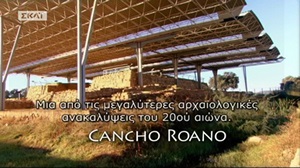
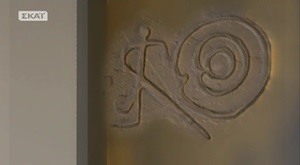
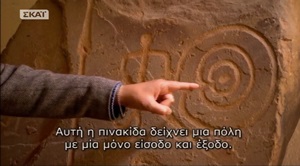
Freund thought that the surviving atlanteans would have gone to other areas where they would have built smaller cities, like miniatures, in memory of their ruined homeland. To confirm this theory, he searched with a Spanish scientist in the surrounding area for archeological sites surrounded by several concentric moats, and eventually traveled to a museum containing many examples of "standing stones" engraved with a symbol resembling Plato's drawings of Atlantis. "There are more than 100 of them, and they come from all different places in the area," Freund said. The similarity of the stones convinced Freund that the surviving Atlanteans had built tributes to their destroyed city throughout Spain. In addition to the above standing stones, the researchers' theory is strengthened by the discovery, in Central Spain, of a strange series of traces of other small cities, built according to the model of Atlantis, ie "memorial cities" that are considered to have been built by refugees from Atlantis, further north and deeper inside the country, in remembrance of their ruined homeland One of these discoveries, made during archeological excavations in the 1970s and 1980s, is the ruins of Kancho Roana, which are the remains of a small monumental town inside the Donαna Park, 200 km from the port. There, in the Guadalquivir River Delta, scientists showed us the remains of a city built in steps, with many temples, few settlements and houses, and a deep round moat that surrounded the city. According to Freud, it was a "sacred city", a miniature of Atlantis. The most fascinating point of the documentary is when the camera shows the most interesting find that has to do with Atlantis: On a stone, at the main entrance of Kancho Roano (there is also in many other cities) is engraved a symbolic representation. It is a relief secret symbol. The figure of a warrior is formed with a drawn sword that "guards" the entrance of the city, which is represented by concentric circles. The sign shows the concentric circles with a single input which is also an output. Its resemblance to Plato's description of the shape of Atlantis (three land rings and two water rings with an entrance-exit to the South, and in the middle the citadel with the palace of Poseidon) is obvious. Freud and his team try, with their research, to solve two ancient mysteries. One platonic and one biblical. The biblical refers to the lost city "Tharseis" which is mentioned many times in the Bible. Many experts believe that "Tharseis" is another name for the ancient famous city "Tartissos". Most experts agree that "Tartissos" was in southern Spain, as well as the city "Tharseis". According to Freud, "Tartissos" and "Tharseis" were one and the same. Ancient sources mention both cities as exploiting their metals. Merchant ships from the Middle East traveled for three years to obtain supplies from these cities. Surprisingly, both names disappeared from historical and biblical references. As if the city ceased to exist. This happened, according to Freud, because in antiquity "Tartissos-Tharseis" was known by another name, Atlantis. So Tharseis = Tartissos = Atlantis. All three cities are listed as important ports located on an island at the edge of the then known world where ships come from the great seas, it took 3 years to complete this voyage and as mysteriously disappeared. But their striking similarities continue. They were famous for their wealth in ores, mining huge quantities of gold, silver and copper. Even today, just above Donana, the three metals have been mined for 5,000 years on the shady hills of Rio Tinto. They are the famous mines of Rio Tinto.
|