You don't have permission to copy the content.

atlantida Tou Okeanou, in ancient Greek Linear B' script

Select your language

κάτω  


A different Mouseum in Greece

The following interview was made on 2/11/2008 to the journalist George Adamopoulo of the magazine "Mystery". It concerns topics of Atlantis (location, indications), ancient civilizations and mythology, the Greeks, theories about aliens and modern... "intermediate", literature about Atlantis and Santorini, and especially about the Museum of Atlantis that operated until a few years ago in Athens. It is also published on the website: http://www.metafysiko.gr/?p=174


 Museum of Atlantis in Athens!  Author: George Adamopoulos

George Adamopoulos, a member of the Metaphysical Community and the new meta-network's effort, discovered the existence of an Atlantis Museum in Athens and closed a very interesting interview with its founder, Mr. Paschos Theodoros. It is published for the first time and exclusively for the Greek internet on its website www.metafysiko.gr/?p=174

1. Mr. Paschos, you are a researcher with vast experience on the subject of Lost Atlantis and the theories that have been developed around it. How did you decide to take up the subject?

My first contact with the mysterious island was while reading - I was a student at the time - the famous books "The Mysterious Island" and "20,000 Leagues Under the Sea" by Jules Verne. I have been systematically involved with Atlantis since the time I was studying at the ASETEM-SELETE school in 1978-79. I was in my first year of school, a mechanical engineer, when I first read my father Vassilis's book "The Atlanteans, Mr. Dainiken and Not the Gods", which had just been published. Since then I started to be actively involved, learning from my father and taking his passion with this beautiful subject. I was present in all the moments of the research and the museum. Later, when my father passed away in 1993, I was elected director of the museum to continue the work until 2000, where I published my website www.atlantida.gr and later became atlanteans.gr.

 2. Tell us more about the Atlantis Museum. When was it founded?

The Atlantis Museum was founded in August 1981 and was initially privately owned by my father Vassilios Paschos. Then my father drew up a plan for the operation of the Atlantis Museum, which was approved and its intellectual property was secured by the competent services.
In 1982, the Museum was asked for its financial support by the Ministry of Culture (with Melina Mercouri as its minister at the time) and this was answered in a letter that in order to meet the financial and administrative demands of the Atlantis Museum, it had to become a union. Following the advice of this Ministry, at the end of 1982, the Atlantis Museum Promotion Association was established by 21 members, with the approval of the multi-member first instance court of Athens. I participated in the first temporary steering committee elected by 21 members, chaired by my father and then elected a member of the first board of directors of the association, in the first regular general assembly, chaired again by my father. Since then I have been continuously elected to the council. In January 1993, the founder of the Museum, Vassilis Paschos, passed away and I was elected president and all the members encouraged me to continue the operation of the museum, a fact that took place until 2000.

3. Have you ever asked for / received the help of the state or an individual for your efforts regarding the Museum? And if not, why not seek state or municipal support? Do you think it could be given today?

Although the Ministry of Culture recommended that an association be set up so that the Museum could be legally strengthened, in the end it did not strengthen it at all, not even symbolically. Of course, many promises were made, but practically nothing. For example, a promise was made in 1985 that the Ministry of Culture decided to support it financially, in fact the department head in charge even told us the amount that was satisfactory. In the end, however, this fund was not given, it changed course because from what we were informed, it went to the expenses of the European Capital of Culture.

4. May be help from an individual?

There was no aid from public or private institutions, neither in money nor in housing or donation of exhibits. Proceeds came from the members of the association but many individuals individually donated to the museum, either small financial support or offers on exhibits: paintings, metal cabinets, books, showcases, closets and more. For each donation, the corresponding certificate was given and written in the donation book that had been opened.

Mr. Theod. Passion in front of exhibits of the Atlantis Museum in Athens.


 5. What exhibits did the museum include? Where did they come from?

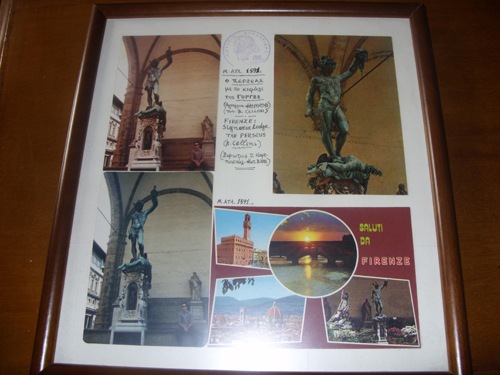
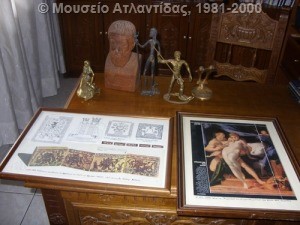
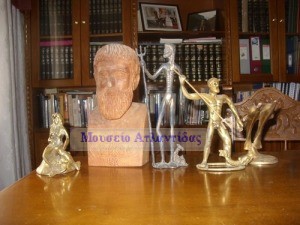
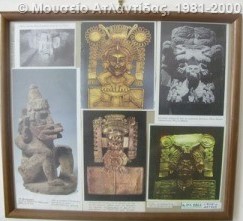
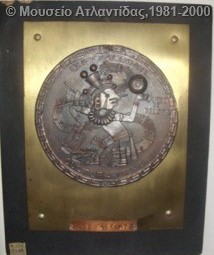
The exhibits of the museum were all objects reminiscent of the lost Atlantis, that is, every human work or strange natural find that originated and was invented by the legend and history of the Atlanteans, of Atlantis and their descendants. Indicatively we can say that it included the following categories: Books, various publications, magazines, newspapers, etc. that were of course related to Atlantis, works of art with the heroes and findings of the Atlanteans, various types of folk art, clay, glass, metal, embroidered, maps, paintings, photographs, postcards, slides, sketches, titles, stamps, handicrafts, industrial items, etc. reminiscent of Atlantis, Atlas, Poseidon and her other heroes and the recognizable symbols of Atlantis, which were trident, dolphin , circular spirals, mermaids, Sun, Moon, snake, eel, double ax, bull and which findings are also presented in Greek mythology. As for the archeological objects now, archeological objects could not be present in the museum because such strange objects found in various researches (plates, crystals, etc.) at times made by researchers from the USA and Russia, were found in Spain, Mexico, Guatemala, at the bottom of the Atlantic Ocean, these are of undetermined origin and are still being examined. They are inaccessible even to Atlantologists and are only researched by a close circle of expert scientists who also do secret research. Nevertheless, the museum has been able to take photographs of these findings, of course those that have been released. Other exhibits of the Museum are statues, busts, paintings, inscriptions, representations, vases, shells, coins. Also, linguistic elements of unknown origin, hieroglyphic symbols and the presentation of the great writers of Atlantis starting from the ancients. Especially the collection of books that the museum has is huge.

6. Which do you consider to be the most important exhibit of the museum, or the most favorite for you personally?

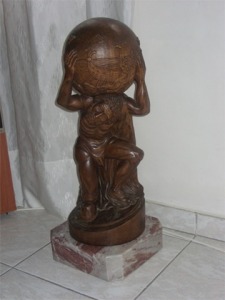
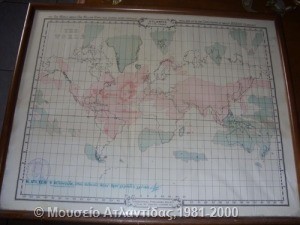
These are some maps that exist in the museum and are very old, I have a map here and a statue of Atlanta holding the Globe, which I have here today.

7. Do you want to tell us more about them, ie date etc?

The statue is a new construction, I got it from the Advent of Atlanta and I like it as an exhibit. The map is from old maps we found in an old book, which we photographed, enlarged and framed.

8. What was the response of the people. Did it have traffic?

The museum was visited by journalists, artists, archaeologists from various countries. We also had organized visits for elementary, high school and high school students. Events were held, mainly by writers, and these events were again organized for writers. But there were also occasional, individual visitors because it was open two to three times a week.

Εxhibit of the Atlantis Museum in Athens

9. What were the difficulties that your father encountered in carrying out this project?

The difficulties were not only financial. The biggest difficulty was the housing of the museum and this of course in relation to its financial support. It was a problem that was not solved until the end of its existence. I will tell you a story about the problems we encountered, about these issues. Until 1983, the museum was housed here, in this house we are in today. Here, I remember there were a lot of exhibits, it was full and in the space that was down, in the basement. However, the old items that had been collected, at some point reached the number 1000 and could not be exhibited in the house. So a room was rented in January 1984 in New Heraklion but then new expenses began to run, such as rent, utilities and bills. But the new room after three years again became small because the number of exhibits increased, reaching around 1800 exhibits. In 1988, the Museum moved again to a new room, this time larger, in the Neo Kosmo. This room was bought by my father, Vassilis Paschos, with money from the lump sum of his pension. There began the new season of the museum, which was the best because at that time many channels were interested in showing it, many journalists visited the room to report and interview. Nevertheless, the new space proved to be unsuitable because it was a basement in an apartment building. This was not immediately apparent, but it was much later, in 1995 and 1998-99, when major disasters, floods and the museum flooded the area twice, causing the destruction of many exhibits and equipment.

10. Approximately how many exhibits did the museum host? You said 1800, then they went up again?

They went up. At the moment in the books that I see, because we were recording them in a book, I see around 2500 exhibits. Of course, many of them have been destroyed but there are many that are left.

11. Finally, when and why did the museum close?

The museum remained open to the public until after the second disaster, which occurred in 1997 or 1998, as far back as I can remember. It took a long time for the place to be visited again, and the museum stopped operating for 6-7 months at that time. It was then proved that the site was unsuitable, due to the fact that it could not be protected from floods with some technical solution. It was then decided that the exhibits should be relocated to another protected area. So he left the place over there, in 1999 I slowly started to take the exhibits from this place, but in which place should I put them? There was no other room. The only place was again here in my house, where I lived. So, little by little, I moved the museum, the most important exhibits were transferred again to the same place from where it first started: to my own house now, in New Heraklion. The exhibits are currently stored and can not be displayed, no one can see them. Thus, the museum essentially closed. My decision to close the museum and move the exhibits came under the pressure of necessity. I could no longer maintain an unsuitable space, which after the disasters was under-functioning and was combined with my decision to build the website with my own domain name, in which I would project new data, knowledge and theory of Atlantis that had been hoarded. It was a quick and economical way for me and without risk, to continue the projection of Atlantis. So in 2000 I created the website atlantida.gr, in Greek and English at the beginning and after 2005 the site was renamed to atlanteans.gr.

Εxhibit of the Atlantis Museum in Athens

 12. So the exhibits (all of them saved) were moved here, to the place where we are now and are not open to the public?

No, they are not visitable because most of them are stored.

13. Are there any plans on your part for a future revival of the museum?

No, I do not intend to revive the museum. The problem of housing and financial aid remains and I have no illusions that it will be solved. My father tried very hard to solve it but it was not solved. I do not think anyone will fund a museum with such an issue, the illusions are over. Nevertheless, my passion remains, this has not changed and my immediate goal is to promote the museum exhibits on the internet and on my website atlanteans.gr. The new technology helps in the faster and wider display of the museum. Already on this website I have a report about the museum, its purposes and history.

14. So do you intend to digitize the exhibits?

ΝYes, my purpose is to digitize the exhibits and process them electronically, mainly processing is a very time consuming job. I have already done some of them, but the work has to be completed in order to promote them on the internet. The site exists but the websites must be expanded. I think it will take me some time. My other plans are to continue my research on Atlantis, something I will definitely do and already do, and my participation in international conferences on Atlantis, because I have a lot to present. As for the museum, I will make a judgment. I think it was a very innovative idea of ​​my father, we also had letters from foreigners to come and see the museum. Internationally innovative idea. But in the end, it's not enough just the eagerness and passion that a researcher has nor the individual offers he makes to survive a nice idea.

Εxhibit of the Atlantis Museum in Athens


15. But let's move on to Atlantis theory. Based on your research, are you convinced that Atlantis existed? Is there evidence - archaeological finds for this?

Mayan-Aztec myths speak of their god Quatzakuatl, that he came from a strange land of the rising sun. Myths in Greece mention the island of Makari, located in the West, in the Ocean. All these references to myths converge on a geographical area and the existence of a country. Archaeological finds have now been discovered which are the most important that have been found, have been discovered by the Americans in the Bahamas and the Russians in the Azores, sunken ancient ruins, cyclopean walls, stairwells, etc.
It was found with sonar, a geological construction in the shape of a pyramid, at a depth of 300 meters near the Bermuda Triangle. Special equipment has pulled a 15,000-year-old rocky islet from a land volcano 2800 meters deep into the Atlantic. Another great find is the famous maps of Piri Reyes, Plato's references to Timaeus and Critias. Also important is the place names that exist, which are ancient place names Contain the synthetic "atl", "otl" that exist in Morocco, Guatemala, Mexico, those that exist on both sides of the Atlantic

16. Give us an example of this ..

The areas in Guatemala, Mexico, Tenocitlan eg, the Atlas Mountains on the Moroccan side. I have made a map, which I do not have at the moment, to show you, in which there are equal to 100 place names, in Guatemala, the coasts of Mexico, South America and the coasts of Africa that all contain the synthetic "atl". I should also mention the references of the ancient Greeks to Atlantis, such as Homer, Hesiod, Herodotus, Aeschylus, Plutarch, Crates, Aristarchus, Apollodorus... It is wrong what some say, that only Plato mentions Atlantis, or that before Plato Atlantis was not mentioned by any ancient writer. There were reports of Atlantis. What else can we say? Other finds: The bottom of the Atlantic is volcanic, lava was pulled from there, mined from the bottom from a depth of 3,000 meters and found to be glassy basalt, which geologists confirm is a lava element of land and not a submarine one. Of course, all these are indications and not proofs.

17. Are you convinced that Atlantis was indeed in the Atlantic Ocean and not e.g. in Santorini as claimed by Professor Sp. Marinatos, or somewhere else? I am asking you because there are currently a number of paradoxical theories about the true location of Atlantis and its inhabitants. Many even talk about the extraterrestrial origin of the Atlanteans!

I believe that Atlantis existed and from the elements I mentioned I defined the space, that is, in the Atlantic Ocean. Now, on the issue of Santorini, Marinatos did investigate the matter, but he could not prove himself based on the findings of the excavations in Thera that Atlantis was in the Aegean, on the part of the island that sank. Of course, he mentions this in his writings, he even says that Atlantis is still an enigma and that there is the problem of Atlantis. In other words, he was not sure. In Santorini in general, a lot of research has been done that continues to this day, remarkable findings have been found but they do not prove anything about Atlantis. Santorini has been explored for a century now, but it has not been proven that Atlantis was there. That is why I believe that the paraphilology about the existence of Atlantis in the area of ​​Santorini should stop or the other paraphilology that says that the eruption of the Santorini volcano created the flood that sank Atlantis. This is refuted by a simple fact, that the flood of Atlantis was global, had an effect on the whole Earth and for this reason refers in the same way to the mythologies of almost all civilized peoples. On the contrary, the eruption of the volcano of Thira created a tsunami that had devastating effects on the shores of the Aegean and in only one part of Crete, as has been proven so far by research. From the findings found in Santorini, a number of remarkable conclusions emerge: First, the exact date of the eruption of the Santorini volcano was determined, which according to the announcement made in 2006 was between 1627 and 1613 BC. Most of the finds were of Cretan-Minoan origin and it turned out that there were indeed clear trade relations between the inhabitants of Prehistoric Thira, Crete, Cyprus, Egypt and the Aegean islands, both before and after the volcano eruption.
I would also like to mention some other theories, not just with aliens, that have recently grown and placed Atlantis in incredible geographical locations, almost where archeological finds have been found, underwater or above ground. In fact, these theories try to match the geological and geometric elements of this space with the references to Plato, or misinterpret and distort these references to fit them into the existing space. I answer to all of them that the research has now focused on the Atlantic Ocean, starting from places where Cyclopean Walls and Pyramids have been found. The project is very difficult and expensive, but research must be funded, with the aim of modern submarines going down the rocks, excavating, cleaning them, stripping them of algae and mud, and studying them for inscriptions. wedged coins etc, an inscription for example in a strange language that mentions the word Atlantis or a coin with representations and symbols is proof of Atlantis. So far, however, nothing has been found and we remain in the indications. However, if something is found, the history of the world, the educational books and the relevant perceptions must change, the whole edifice on which our modern culture is based.

Some exhibits of the Atlantis Museum in Athens

18. Over the years you will have heard various theories about the lost continent. What's the weirdest theory you've ever heard and how do you respond to it?

The strangest theory I have heard is the extraterrestrial origin of the Atlantean civilization, according to others the extraterrestrial origin of the Greeks and the Atlanteans, others say that life itself has an extraterrestrial origin. Nor have they decided exactly what they support and want to say. These theories were started on a massive scale by Dainiken in the 1970s and 1980s. I can not imagine the aliens running with vaccines in their hands to change the barbaric people of Earth. The answer to Dainiken was given at that time by Vassilis Paschos, in a letter that was sent personally and which is published in the introduction of his first book "The Atlanteans, Mr. Dainiken and not the Gods". Dainiken responded to my father's letter and wrote "Give me time to study the issues you mention and I will answer you", but officially, no answer ever came. In the last decade, these theories have become even more numerous than in the time of Dainiken. Letters have been sent about interplanetary alien travels to Earth, about conflicts between aliens, and even median, supposedly gifted humans have appeared who can come into spiritual contact with extraterrestrial beings from the Constellation of Andromeda or from Sirius.
I consider all these fairy tales of Halima. I answer to all of them that civilization on Earth was self-sown (native), the primitive communities that emerged in many parts of the Earth evolved little by little, after many millennia, and each created its own level of civilization. From these, the Atlanteans stood out and developed their own culture because of their better geographical location and better climate they had.


19. I imagine you will be familiar with the theories of Edgar Cayce! Do you think there is any truth when he said that the time when Atlantis will emerge will come soon and that we will discover the Lost Hall of Chronicles under the feet of the Egyptian Sphinx?

Now you have opened a big chapter with Cayce because he is going to the field of metaphysics. I will tell you in a few words so that people understand.

Edgar Cayce was an American therapist and clairvoyant who had the ability in a state of self-hypnosis to diagnose his own illnesses and that of other people who came to him for help, and he did provide treatments that were medically strange but effective. Cayce spent his entire life dictating to people who were having trouble. But he also believed in reincarnation, often describing the past lives of people here on Earth that reached as far back as 50,000 years ago and who, according to him, lived in a land of Eden called Atlantis. From the many dictations he gave to different people, he found that about 700 of them had incarnations in Atlantis that affected their current lives. Through these dictates of life, Cayse fully analyzed and described the lost Atlantis, gave its place in the Atlantic, the islands that made it up, their names, described the uprisings of its inhabitants and described the destruction of Atlantis. According to his theory, many entities that had one or more incarnations in Atlantis are reincarnating on Earth in this century, and especially in America. But many of his dictations were found to be true. In a dictation made in, say, 1940, Cayse predicted that parts of Atlantis would emerge around 1968-69. Indeed, in 1968 the underwater Cyclopean walls were found on the island of Bimini, in the Bahamas. Keys's case is shocking and should be analyzed in the light of genetics and biology. What do these findings say? That the primordial memory and consciousness, the collective consciousness that man acquires, that is, the memory of our ancestors in common, is recorded in the core of human DNA and is inherited to future generations. I believe that Keys managed to awaken this collective memory from its lethargy. I believe that with the discovery of Atlantis, Keys will prove to be a true prophet.

20. So, will the chronicle's room be discovered?

In many of his dictations, Keys says that the Atlanteans, before the catastrophe, moved their archives to Egypt and two other places to preserve them and that one day they will be found. Specifically, in a dictation he says that the archive room is located between the Sphinx and the river. In another he says that the room is located in the passage between the Sphinx and the Pyramid of the archives. At these points, however, between the Sphinx and the river, where the Nile used to be closer to the Sphinx than it is now, no records have been found so far. However, he said that the archives were also preserved in other places, such as somewhere on the Yucatan Peninsula and in Atlantis itself, which sank and the archives will be found when this point is investigated. Now, is this a real recollection of recorded human DNA information or misinformation? Nobody knows. I do not think the issue has been decided yet. Time will tell.

Some exhibits of the Atlantis Museum in Athens

21. Regarding what Plato records about Atlantis in his works, is it considered to be accurate and historically true or is it a symbolic story, a social-psychological allegory?

I think it is accurate. I will not go into too much detail because it has been much discussed, but in a few words there are geographical elements in Plato's description, for the form and shape of the Heraklion Columns, for some parts of the Atlantic and for a new continent, beyond Atlantis, which he does not name . After all, Plato's references are certainly an element of my research, but not the most serious. However, I can not imagine that Plato fooled the whole world and I give an answer to those who say that what Plato says is not true. What was Plato? Was he a scammer? But let's take this subject from another angle. Suppose Plato did not tell this story at all, that we knew nothing about Atlantis from his writings. Wouldn't we be looking for a pre-flood culture again today? There are so many clues around the world, so many unexplained findings and phenomena, references and myths, that we would do it. Plato simply gave us the name of civilization and guided us. After all, as we have said, there were earlier references to Atlantis by Plato.

22. Are there any descendants of the Atlanteans today?

Yes, i think there are. There are specific tribes that I can name. They are the Basques of Spain, living in the Pyrenees. They differ from their neighbors in appearance and language and in fact the Basque language is the only one in Western Europe that is not an Aryan language. The Canary Islands, which bear little resemblance to any other African tribe and used to embalm their dead. Other tribes are the Berbers of North Africa, who have language idioms influenced by the word "tlas", but also a small, relatively unknown tribe, the Dogon people, who live in South Mali, West Africa. They still worship Sirius, have astronomical knowledge and say they are descended from the Berbers, but they clearly state that they are descended from the Atlanteans. I also think that the tribes that come from the Atlanteans should include the American Indians and other tribes that I do not have in mind.

23. The Greeks;

I can not answer this question because there are many admixtures... The Greeks made their own culture and in many things they can have influences, but ... Anyway, there are influences from Atlantis in the Aegean islands, in traditions, in mythology... Let us not forget that Zeus was born on a mountain in Crete, taken by Rhea to save him from Saturn, who lived on an island in the Atlantic and ate his children. That is why Rhea went to Crete and gave birth to Zeus there, far from Saturn. Also, the worship of the twelve gods started from Crete, the traditions of Crete, such as the bull, etc. related to the traditions of the Atlanteans. There is a correlation between the two cultures but the Greeks made their own culture, many mixes were made .. Maybe this culture overshadowed the influence of the Atlanteans and for this we can not answer with certainty whether the Greeks are descendants of the Atlanteans or not.

Some exhibits of the Atlantis Museum in Athens


24. Why do you think Atlantis sank? It was just a geological event (eg due to volcanic activity) or its inhabitants were responsible as some theories that attribute the causes to the misuse of some super-technology.

Based on the data I have collected, I believe that the sinking of Atlantis took place in parts and not in one day and one night, as Plato mentions. In fact, it happened in at least two disasters, there may have been three. Part of Atlantis and many of its islands sank during the time when the ice melted rapidly (9000-11000 BC). The total destruction, however, took place in earlier years (6500-7500 BC). Natural phenomena (volcanoes, earthquakes, storms and possibly meteorites) contributed to this, but there may have been phenomena of misuse of technology, this is present in all advanced civilizations. I think that in the end there is no exact answer to this question. Edgar Cayse spoke of the misuse of technology. However, I believe that we should not try to give an answer to this question when we have not yet acknowledged its existence. First to recognize its existence and then to deal with this issue.

25. Indicative date for immersion?

I would say that the first catastrophe took place around 9,500-10,000 BC, at a time when many scientists believe that the ice melted. The final destruction I believe took place around 7-7,500 BC. I have some facts about this which I intend to share in the future.

26.You recently took part in the 2nd International Conference on Atlantis that took place on November 10-11, 2008, in Athens, with the participation of many reputable scientists from Greece and abroad. Would you like to tell us about your participation in this?

I participated in this conference, which took place on November 10 and 11, 2008, because I have collected enough data in my archive and I decided that it was time for them to be presented, for people and other researchers to read. My purpose was to offer my humble opinion on the subject of Atlantis. My participation in the conference was in the form of a poster presentation and my theme was "A New Map of Atlantis - Atlantis was partially submerged in at least two disasters". This participation will give me the opportunity to enter some of the data and information I have in my possession, in the conference minutes, which will be published in a book. As for these facts now, first I explain the position of Atlantis shown on the map and second I explain why Atlantis was partially submerged with at least two disasters. I intend to complete this topic and hope to complete it at the next conference, which will be held in Santorini in two years.

27. How can someone read your theories and get in touch with you and your work?

First of all, from the websites I maintain that are with my own domain name and are in both languages. I also maintain a blog, which is in the spaces of msn spaces, and there someone can find me. All these sites are related not only to Atlantis but also to other ancient finds and there I present my theory. Also another way is to read my father's book "The Atlanteans and Not the Gods", which I printed in a new edition in 2004 by Georgiadis Publications. There, most theory is mentioned and also just get me a phone.

Exhibit of the Atlantis Museum in Athens

28. What does your father mean by the title "The Atlanteans and not the Gods?

Ο The original title of the book was "The Atlanteans Mr. Dainiken and Not the Gods" and it was just to give an answer to Dainiken. But then the book took on a more general form and became "The Atlanteans and Not the Gods." The phrase "Not the Gods" is a response to those who believe that aliens were the Gods who brought civilization to Earth and accordingly states that the Atlanteans were the ones who brought civilization and were native.

29. Your plans for the future?

First of all, to participate in the international conferences for Atlantis that are taking place, whatever is happening in various places. Another plan is to expand my website with museum exhibits. For the book you asked me about, I do not intend to publish a new book about Atlantis because I notice that this topic is too saturated. Maybe I can publish a small booklet that summarizes the research on Atlantis in a short way, but also what the ancient Greeks said about it. But at the moment I also have a science fiction book, I think it will have a longer run. It has to do with aliens, the contacts they have with earthly people and in fact there are two Greek scientists in these contacts, but also with Atlantis. I am currently looking to find a publisher to publish it.
Another plan for the future is to create an Association of Friends of Atlantis, as long as you find people who are interested in this topic, have the appetite to run and time but also have some "madness" because only madness can promote this issue.

30. What do you think is the strongest evidence, or the most solid indication, that Atlantis existed?

There can be no solid evidence, by itself, for the existence of Atlantis. Not even Plato's reference is a firm indication, and I say this because so many Atlantologists rely on Plato. However, the combination of all these serious indications, forms a single, firm indication. I said the serious signs (buildings - mythologies). I would like to mention a great clue. Maps of Piri Reis in 1513. One of these maps is the map of the coasts of the countries surrounding the Atlantic Ocean. It presents Antarctica and Greenland without ice, with absolute accuracy. In the map memoir, Piri Reis states that the source of this map is eight old maps of Ptolemy and some other newer sources. But who was Ptolemy? He was the king of Egypt, the one who built the library of Alexandria. Ptolemy collected all the maps that existed in his time, mainly old and placed them in the library of Alexandria. In fact, Ptolemy was the one who called these maps "Atlantes". Is this name random? I believe that these maps were created by Atlantis scientists who survived the first catastrophe.

Note: Part of this interview was originally published in mystery magazine, issue 49.


Books Presentation

Science Fiction

Μυθιστόρημα: "Επικοινωνία με Νοήμονα Όντα"

Author: Theodoros Paschos. Pages 320

Two Greek scientists with their technology find solution to the problem of communication with intelligent beings in the universe chasing the future of humanity. Seeking to solving various mysterious phenomena starring in Mission Teams to watch the flying saucers that appear on Earth to Mars and the Moon and to communicate with extraterrestrial beings. In doing so they get involved in adventurous and dangerous stories, but they also discovered the remnants of the technology of Atlantis into the ocean depth.

You can preview or get the book from the Website: smashword.com/

The Atlanteans and Not the Gods

atlantes book georgiadis

Author: Vassilis Th. Paschos. Pages 350

The author Mr Vassilis Paschos, with this book penetrates research into antiquity and by demystifying legends and traditions, proves the existence of the Atlanteans. For their original residence, the cradle of its culture, their lost country, the author quotes rich material and convincing facts ...

See reviews of the book: "The Atlanteans and not the Gods"

Order the book

Atlantes, Not the "Gods"

Atlantes, Not the Gods

Αuthor: Vassilis Th. Paschos. Pages 80

The new and daring theory of Mr Paschos, is based on elements from Homer, Hesiod, Plato, Proklos, Plutarch, Markellaus and other ancient Greek and Latin writers (their works are mentioned in his book), on Egyptian papyrus, the Gilgames epic poetry of Babylonians, the Bible, the traditions of the people around Mediterranian and Central America and on ancient findings in these areas.

You can preview or get the book from the Website: Smasword.com/