5. What exhibits did the museum include? Where did they come from?
The exhibits of the museum were all objects reminiscent of the lost Atlantis, that is, every human work or strange natural find that originated and was invented by the legend and history of the Atlanteans, of Atlantis and their descendants. Indicatively we can say that it included the following categories: Books, various publications, magazines, newspapers, etc. that were of course related to Atlantis, works of art with the heroes and findings of the Atlanteans, various types of folk art, clay, glass, metal, embroidered, maps, paintings, photographs, postcards, slides, sketches, titles, stamps, handicrafts, industrial items, etc. reminiscent of Atlantis, Atlas, Poseidon and her other heroes and the recognizable symbols of Atlantis, which were trident, dolphin , circular spirals, mermaids, Sun, Moon, snake, eel, double ax, bull and which findings are also presented in Greek mythology. As for the archeological objects now, archeological objects could not be present in the museum because such strange objects found in various researches (plates, crystals, etc.) at times made by researchers from the USA and Russia, were found in Spain, Mexico, Guatemala, at the bottom of the Atlantic Ocean, these are of undetermined origin and are still being examined. They are inaccessible even to Atlantologists and are only researched by a close circle of expert scientists who also do secret research. Nevertheless, the museum has been able to take photographs of these findings, of course those that have been released. Other exhibits of the Museum are statues, busts, paintings, inscriptions, representations, vases, shells, coins. Also, linguistic elements of unknown origin, hieroglyphic symbols and the presentation of the great writers of Atlantis starting from the ancients. Especially the collection of books that the museum has is huge.
6. Which do you consider to be the most important exhibit of the museum, or the most favorite for you personally?
These are some maps that exist in the museum and are very old, I have a map here and a statue of Atlanta holding the Globe, which I have here today.
7. Do you want to tell us more about them, ie date etc?
The statue is a new construction, I got it from the Advent of Atlanta and I like it as an exhibit. The map is from old maps we found in an old book, which we photographed, enlarged and framed.
8. What was the response of the people. Did it have traffic?
The museum was visited by journalists, artists, archaeologists from various countries. We also had organized visits for elementary, high school and high school students. Events were held, mainly by writers, and these events were again organized for writers. But there were also occasional, individual visitors because it was open two to three times a week.
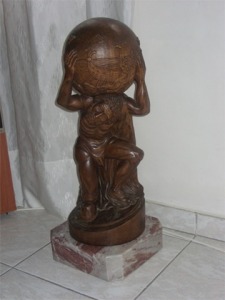
Εxhibit of the Atlantis Museum in Athens
9. What were the difficulties that your father encountered in carrying out this project?
The difficulties were not only financial. The biggest difficulty was the housing of the museum and this of course in relation to its financial support. It was a problem that was not solved until the end of its existence. I will tell you a story about the problems we encountered, about these issues. Until 1983, the museum was housed here, in this house we are in today. Here, I remember there were a lot of exhibits, it was full and in the space that was down, in the basement. However, the old items that had been collected, at some point reached the number 1000 and could not be exhibited in the house. So a room was rented in January 1984 in New Heraklion but then new expenses began to run, such as rent, utilities and bills. But the new room after three years again became small because the number of exhibits increased, reaching around 1800 exhibits. In 1988, the Museum moved again to a new room, this time larger, in the Neo Kosmo. This room was bought by my father, Vassilis Paschos, with money from the lump sum of his pension. There began the new season of the museum, which was the best because at that time many channels were interested in showing it, many journalists visited the room to report and interview. Nevertheless, the new space proved to be unsuitable because it was a basement in an apartment building. This was not immediately apparent, but it was much later, in 1995 and 1998-99, when major disasters, floods and the museum flooded the area twice, causing the destruction of many exhibits and equipment.
10. Approximately how many exhibits did the museum host? You said 1800, then they went up again?
They went up. At the moment in the books that I see, because we were recording them in a book, I see around 2500 exhibits. Of course, many of them have been destroyed but there are many that are left.
11. Finally, when and why did the museum close?
The museum remained open to the public until after the second disaster, which occurred in 1997 or 1998, as far back as I can remember. It took a long time for the place to be visited again, and the museum stopped operating for 6-7 months at that time. It was then proved that the site was unsuitable, due to the fact that it could not be protected from floods with some technical solution. It was then decided that the exhibits should be relocated to another protected area. So he left the place over there, in 1999 I slowly started to take the exhibits from this place, but in which place should I put them? There was no other room. The only place was again here in my house, where I lived. So, little by little, I moved the museum, the most important exhibits were transferred again to the same place from where it first started: to my own house now, in New Heraklion. The exhibits are currently stored and can not be displayed, no one can see them. Thus, the museum essentially closed. My decision to close the museum and move the exhibits came under the pressure of necessity. I could no longer maintain an unsuitable space, which after the disasters was under-functioning and was combined with my decision to build the website with my own domain name, in which I would project new data, knowledge and theory of Atlantis that had been hoarded. It was a quick and economical way for me and without risk, to continue the projection of Atlantis. So in 2000 I created the website atlantida.gr, in Greek and English at the beginning and after 2005 the site was renamed to atlanteans.gr.
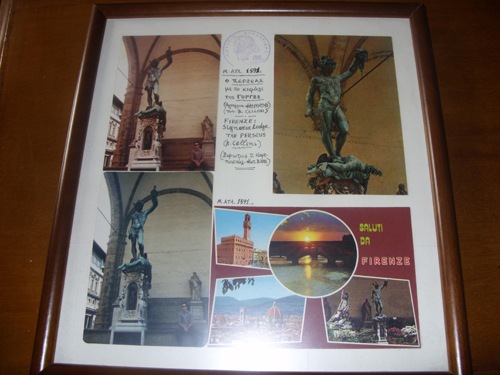
Εxhibit of the Atlantis Museum in Athens
12. So the exhibits (all of them saved) were moved here, to the place where we are now and are not open to the public?
No, they are not visitable because most of them are stored.
13. Are there any plans on your part for a future revival of the museum?
No, I do not intend to revive the museum. The problem of housing and financial aid remains and I have no illusions that it will be solved. My father tried very hard to solve it but it was not solved. I do not think anyone will fund a museum with such an issue, the illusions are over. Nevertheless, my passion remains, this has not changed and my immediate goal is to promote the museum exhibits on the internet and on my website atlanteans.gr. The new technology helps in the faster and wider display of the museum. Already on this website I have a report about the museum, its purposes and history.
14. So do you intend to digitize the exhibits?
ΝYes, my purpose is to digitize the exhibits and process them electronically, mainly processing is a very time consuming job. I have already done some of them, but the work has to be completed in order to promote them on the internet. The site exists but the websites must be expanded. I think it will take me some time. My other plans are to continue my research on Atlantis, something I will definitely do and already do, and my participation in international conferences on Atlantis, because I have a lot to present. As for the museum, I will make a judgment. I think it was a very innovative idea of my father, we also had letters from foreigners to come and see the museum. Internationally innovative idea. But in the end, it's not enough just the eagerness and passion that a researcher has nor the individual offers he makes to survive a nice idea.
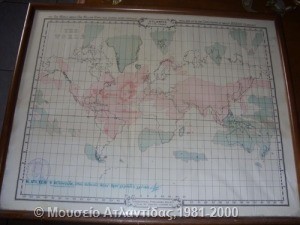
Εxhibit of the Atlantis Museum in Athens
|


